Application settings
Consider any list of fields of activities that involve people, and you can find a rich array of decisions. For example:
- Engineering, including any engineering discipline, spanning both laboratory testing and field implementation
- Physical and biological sciences
- Computer science and mathematics
- Public health, covering the treating of diseases and other health conditions
- Medical systems, spanning medical decision making to hospital care
- Economics and finance
- Energy systems
- Supply chain management, manufacturing and freight transportation
- Personal and public transportation
- E-commerce
Pick any setting, and you will find people trying to invent new materials and products, create software, develop new drugs, and improve a wide range of processes.
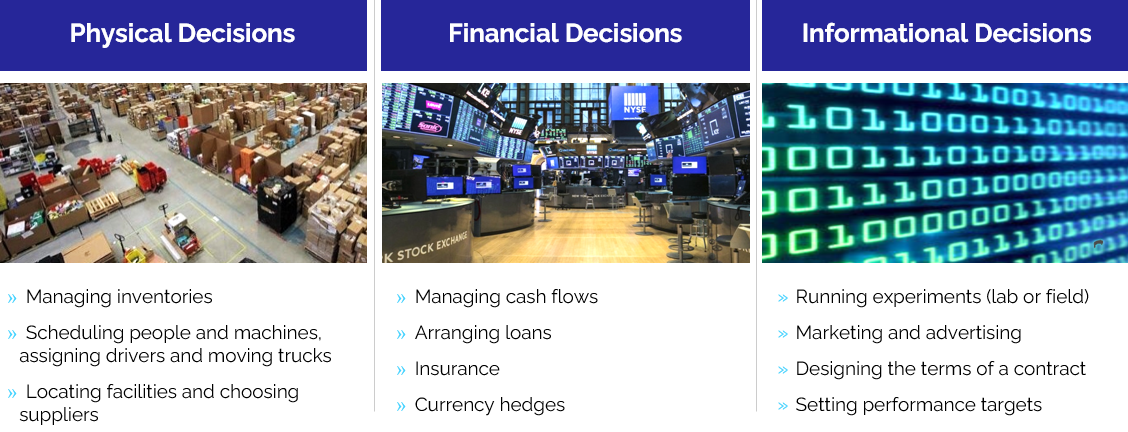
We can describe decisions as coming in three broad flavors depending on whether they are acting on physical, financial, or informational resources.
Jump to a section
Physical decisions
Without question the category of managing physical resources offers the richest class of applications for making decisions. Physical resources include people, machines, facilities, chemicals, a countless variety of inventories, trucks (tractors and trailers), trains (locomotives and cars), aircraft, and all the random assorted equipment that comes into play in each of these environments. Decisions control buying, selling, moving, and any of a range of modifications (repairs, setups, education / training).
The most common source of uncertainty in the management of physical resources is serving customer demands and requests that arrive randomly over time, sometimes with some advance notification. However, other sources of uncertainty involve the time required to perform a task, the quality of the task, and the usual flow of breakdowns and maintenance requests.
Financial decisions
The management of financial resources covers the entire world of investments, whether in financial investments (stocks, certificates, funds), funding major purchases, hedging against currency shifts, and managing loans. The decision made by Ford to arrange a massive leveraged loan package saved the company from bankruptcy during the 2008 financial meltdown.
The most visible financial decisions involve trades (buying and selling investments, managing portfolios) and pricing. Financial trading represents one of the largest and most lucrative areas of application of (deterministic) optimization software.
Uncertainty is the reason that finance is even a field, so it should not be surprising that finance has raised the art of making decisions under uncertainty to a high art. Investment firms and large banks have to show that they have the financial reserves to handle a wide range of events, where the most complex dimension is handling correlations.
Informational decisions
“Information” represents parameters, values, and the choice of functions in the form of rules, terms of a contract, and even methods for making decisions (where we have to choose the method). We might have to design the terms of a contract for purchasing an aircraft, or specify the conditions under which a contract can be exercised or cancelled.
Using an optimization model to make decisions is very familiar in operations research, but the decision of which model to use, how to design the objective function, and the choice of various parameters is often overlooked as important decisions.
A diverse set of problems
 To imagine the vast diversity of sequential decision problems, think of the largest supermarket or retail center, and the millions of items it may carry. This is how to envision the population of sequential decision problems. Just consider all the different types of decisions, the different sources, styles and flavors of uncertainty, the variety of objective functions, and the physics that govern the evolution of physical, financial and informational resources. Our universal modeling framework can handle any sequential decision problem, and covers any method for making decisions.
Given the diversity of sequential decision problems, we put the highest priority on describing and modeling problems before the traditional academic focus on algorithms.