The people of CASTLE Lab
 Warren B. Powell taught at Princeton University for 39 years, where he was a founding member of the Department of Operations Research and Financial Engineering. In 1990 he founded CASTLE Laboratory, which he directed until his retirement in 2020. He also founded PENSA, the Princeton Laboratory for Energy Systems Analysis, in 2008 until 2014 when he merged it into CASTLE. See his biographic summary for the full story.
 Special recognition is due to my first Ph.D. student, Hugo Simao, who returned in 1990 as the first full-time staff member of CASTLE Lab, where he stayed until his retirement 30 years later. Hugo anchored the lab, providing the skill and leadership that could only come from his steady presence, incredible modeling and software skills. Hugo played the central role on projects with Yellow Freight System, Air Products and Chemicals, Schneider National (producing the software that launched Optimal Dynamics), and the development of the energy planning model, SMART-ISO. Just as important was his ability to teach and nurture students getting used to serious experimental work.
I also need to highlight the work of Belgacem Bouzaiene-Ayari, who joined the lab in 1996 as a senior staff member. He handled a number of important projects, but two that really stand out are the development of our locomotive planning model (PLASMA) for Norfolk Southern Railway, and writing Pilotview, a powerful graphics package that was central to our ability to understand and debug these complex models.
Jump to any of the following topics:
- Academic Family Tree
- My last semester
- Post-doctoral placement (15, 11 academic)
- Academic placement (15)
- Research laboratories (5)
- Industry (19)
- Masters theses (11)
Academic Family Tree
70 graduate students (MSE and Ph.D.), post-docs and technical staff, and over 200 senior theses. Graduate students and post-docs found placements in Cornell (2), Columbia, University of Pennsylvania, Yale, University of Maryland, University of Washington, University of Pittsburgh, London School of Economics, University of Toronto, University of Waterloo, University of Buffalo, Lehigh, Stevens Institute of Technology, University of Muenster, University of Twente, Korea University, along with a number of national labs and leading companies.
I would later learn that my 200 senior theses represented the most in the history of Princeton University among research-active faculty. Since their work was not constrained by the need for funding, I found that I could explore an incredibly wide range of topics, often guided by the interests of the students. It was with the undergraduates that I was able to jump-start my energy systems lab before I had lined up funding, as well as explore a number of topics that I simply found interesting. I had a steady flow of students interested in health, an important research area that was otherwise difficult to pursue at Princeton.
The contributions of this talented group of students were central to the progress we made at CASTLE Lab. I spent countless hours struggling with how to model and solve the endless array of applications that I used to motivate our work in sequential decision problems. Most important were the lessons we learned from this computational work.
“Take care of your students, and the research will take care of itself.”

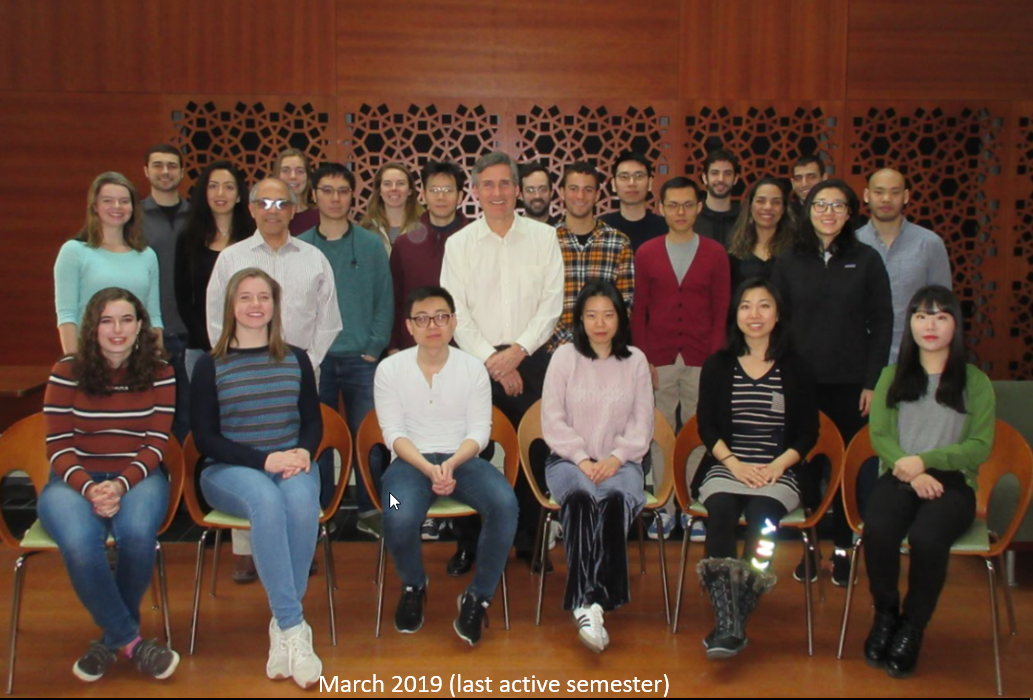
My last semester
As my understanding of sequential decision problems matured, the interest in my work among the students grew steadily. I was supervising 27 grads, undergrads, staff and post-docs in my last semester, when I decided to retire early to get away from a poisonous environment in my department.
At no time did I ever run out of good problems to motivate new research. It is simply impossible to run out of research opportunities when you are working on sequential decision problems.
Post-doctoral placement (15, 11 academic)
- Dionysios Kalogerias, 2017–2019, Michigan State University
- Juliana Nascimento, 2016–2020, Optimal Dynamics
- Lina al-Kanj, 2014–2019
- Saeed Ghadimi, 2020, Management Sciences, University of Waterloo
- Kris Reyes, 2013–2014, 2016–2017, University of Buffalo
- Tsvetan Asamov, 2013–2016 (industry)
- Haitham Bou-Ammar, 2015–2016, American University of Beirut
- Javad Khazaei, 2012–2015, EDF Renewable Energy
- Somayeh Moazeni, 2012–2014, Stevens Institute of Technology
- Ricardo Collado, 2011–2013, Stevens Institute of Technology
- Arta Jamshidi, 2011–2013, Electrical and Computer Engineering, University of Tehran
- Marcos Leone Filho, 2013, Unicamp, Brazil
- Stephan Meisel, 2012–2013, University of Muenster, Germany
- Boris Defourny, 2010–2013, Lehigh University
- Martijn Mes, 2012–2013, University of Twente, Netherlands
Academic placement (15)
- Donghun Lee (CS), 2020, “Learning to Learn Optimally: A Practical Framework for Machine Learning Applications with Finite Horizon.” First position: Korea University, Department of Mathematics.
- Yingfei Wang (CS), 2017, “Advances in Decision Making under Uncertainty: Inference, Finite-Time Analysis, and Health Applications.” First position: University of Washington School of Business.
- Daniel Jiang, 2016, “Risk-Neutral and Risk-Averse Approximate Dynamic Programming Methods.” First position: University of Pittsburgh, Industrial Engineering.
- Ilya Ryzhov, 2011, “Information Collection in Stochastic Optimization.” First position: Robert H. Smith Business School at the University of Maryland.
- Lauren Hannah, 2010, “Stochastic Search, Optimization and Regression with Energy Applications.” First position: Columbia University, Department of Statistics (after a two-year post-doctoral position at Duke).
- Peter Frazier, 2009, “Knowledge Gradient Methods for Statistical Learning.” First position: Cornell University, Department of Operations Research and Information Engineering.
- Kazutoshi Yamazaki, 2009, “Essays on Sequential Analysis: Multi-Armed Bandit with Availability Constraints and Sequential Change Detection and Identification.” First position: Osaka University, Center for the Study of Finance and Insurance.
- Katerina Papadaki, 2002, “Adaptive Dynamic Programming for Aging and Replenishment Processes.” First position: London School of Economics (currently tenured).
- Huseyin Topaloglu, 2001, “Dynamic Programming Approximations for Dynamic Resource Allocation Problems.” First position: Operations Research and Industrial Engineering, Cornell University (currently tenured).
- Mike Spivey, 2001, “The Dynamic Assignment Problem.” First position: Math Department, Samford University. Currently tenured at University of Puget Sound, Math Department.
- Zhi-Long Chen, 1997, “Algorithms for Deterministic and Stochastic Scheduling.” First position: Department of Systems Engineering, University of Pennsylvania. Currently tenured at University of Maryland.
- Raymond K.-M. Cheung, 1993, “Dynamic Networks with Random Arc Capacities: Solution Methods and Applications.” First position: Industrial Engineering, Iowa State University. Currently tenured at Hong Kong University of Science and Technology.
- Judy Farvolden, 1989, “A Primal Partitioning Solution for the Multicommodity Network Flow Problem.” First position: Industrial Engineering, University of Toronto.
- Yiannis Koskosidis, 1988, “Optimization-Based Models and Algorithms for Routing and Scheduling with Time-Window Constraints.” First position: City University of New York.
- Hugo P. Simao, 1987, “Numerical, Discrete-Time Simulation of Transportation Queueing Networks.” First position: Associate Professor, Instituto Tecnologico de Aeronautica, Brazil.
Research laboratories (5)
- Yan Li, 2016, “Optimal Learning in High Dimensions.” First position: IBM T. J. Watson Research Laboratories.
- Abraham George, 2005, “Optimal Learning Strategies for Multi-Attribute Resource Allocation Problems.” First position: Research staff, Princeton University. Second position: AT&T Laboratories.
- Tongqiang Wu, 2004, “The Optimizing Simulator for the Military Airlift Problem.” First position: Lawrence Livermore National Laboratory.
- Tassio Carvalho, 1996, “Dynamic Control of Spatial Resource Allocation Problems.” First position: IBM Watson Research Labs.
- Linos Frantzeskakis, 1990, “Dynamic Networks with Random Arc Capacities, with Application to the Stochastic Dynamic Vehicle Allocation Problem.” First position: AT&T Bell Laboratories.
Industry (19)
- Ahmet Duzgun, 2023, “From Learning to Optimal Learning: Understanding the Impact of Overparameterization on Features of Neural Networks to Optimal Learning of Expensive, Noisy Functions using Low-Dimensional Belief Models.” First position: Squarepoint Capital.
- Xiaohe Luo, 2023, “Entropic Stochastic Search for Expensive, Unimodular Functions and its Application to Stochastic Gradient Algorithms and the Optimization of Parameterized Policies for Supply Chain Planning.” First position: Schonfeld Strategic Advisors.
- Larry Thul (EE), 2022, “Multi-Agent Sequential Decision Modeling for Information Collection and Intervention in Epidemics.” First position: Optimal Dynamics.
- Joseph Durante (EE), 2020, “Stochastic Dual Dynamic Programming and Backward Approximate Dynamic Programming with Integrated Crossing State Stochastic Models for Wind Power in Energy Storage Optimization.” First position: Optimal Dynamics.
- Weidong Han, 2019, “Lookahead Approximations for Online Learning with Nonlinear Parametric Belief Models.” First position: Two Sigma.
- Nana (Kobby) Aboagye, 2018, “Knowledge Gradient for Expensive Locally Quadratic Functions and Stochastic Optimization of Aid Allocation.” First position: Air Liquide.
- Raymond Perkins, 2018, “Multistage Stochastic Programming using Parametric Cost Function Approximations.” First position: T. Rowe Price.
- Si Chen, 2017, “Optimal Learning in Materials Science.” First position: Goldman Sachs.
- Xinyu He (EE), 2017, “Optimal Learning for Nonlinear Parametric Belief Models.” First position: Jump Trading.
- Bolong (Harvey) Cheng, 2017, “Local Approximations and Hierarchical Methods for Stochastic Optimization.” First position: SigOpt.
- Daniel Salas, 2014, “Approximate Dynamic Programming Algorithms for the Control of Grid-Level Storage in the Presence of Renewable Generation.” Ph.D. from Chemical and Biological Engineering. First position: Thomson Reuters.
- Warren R. Scott, 2012, “Energy Storage Applications of the Knowledge Gradient for Calibrating Continuous Parameters, Approximate Policy Iteration using Bellman Error Minimization with Instrumental Variables, and Covariance Matrix Estimation using an Errors-in-Variables Factor Model.” First position: Energy trading startup.
- Jae Ho Kim, 2011, “Quantile Optimization in the Presence of Heavy-Tailed Stochastic Processes, and an Application to Electricity Markets.” Ph.D. from Electrical Engineering at Princeton. First position: AllianceBernstein (fixed-income hedge fund).
- Jun Ma, 2011, “Approximate Policy Iteration Algorithms for Continuous, Multidimensional Applications and Convergence Analysis.” First position: [hedge fund].
- Johannes Enders, 2008, “Mitigating Failure Risk in an Aging Electric Power Transmission System.” First position: Louis Dreyfus Highbridge Energy.
- Juliana Nascimento, 2008, “Approximate Dynamic Programming for Complex Storage Problems.” First position: McKinsey Consulting, Sao Paolo, Brazil.
- Gregory Godfrey, 2007, “Nonlinear Approximation Method for Solving Stochastic, Dynamic Resource Allocation Problems.” First position: Metron Inc.
- Arun Marar, 2002, “Information Representation in Large-Scale Resource Allocation Problems: Theory, Algorithms and Applications.” First position: Amaranth Advisors.
- Joel Shapiro, 1999, “A Framework for Representing and Solving Dynamic Resource Transformation Problems.” First position: i2 Technologies.
Masters theses (11)
- Yinzhen Jin (CEE), 2013, “A Stochastic Model of Errors in Wind Forecasts.”
- Ekaterina Jager, 2008, “Sensor Management.”
- Dennis Panos, 2007, “Approximate Dynamic Programming and Aerial Refueling.”
- Jayanth Marasanapalle, 2000, “Function Approximations for Integer, Stochastic Resource Allocation Problems.”
- Tom Dong, 1998, “A Dynamic Programming Approximation for the Dynamic Assignment Problem.”
- Karthik Sarma, 1998, “Adaptive Nonlinear Approximation Algorithms for Multiattribute Resource Scheduling Problems.”
- Mike Towns, 1997, “The Impact of User Noncompliance and System Stochasticity on Dynamic Routing Problems: A Study of the Truckload Industry.”
- Sheraz Shere, 1996, “A Dynamic Programming Approximation for the Driver Assignment Problem.”
- Tony Snow, 1996, “Adaptive Labeling Algorithms for the Dynamic Assignment Problem.”
- Derek Gittoes, 1994, “A Generalized Labeling Algorithm for Solving the Dynamic Assignment Problem.”
- Mary-Ellen Noyes, 1993, “Validation and Testing of a Stochastic, Dynamic Fleet Management System.”